
Beautiful Plants For Your Interior
Beautiful Plants For Your Interior

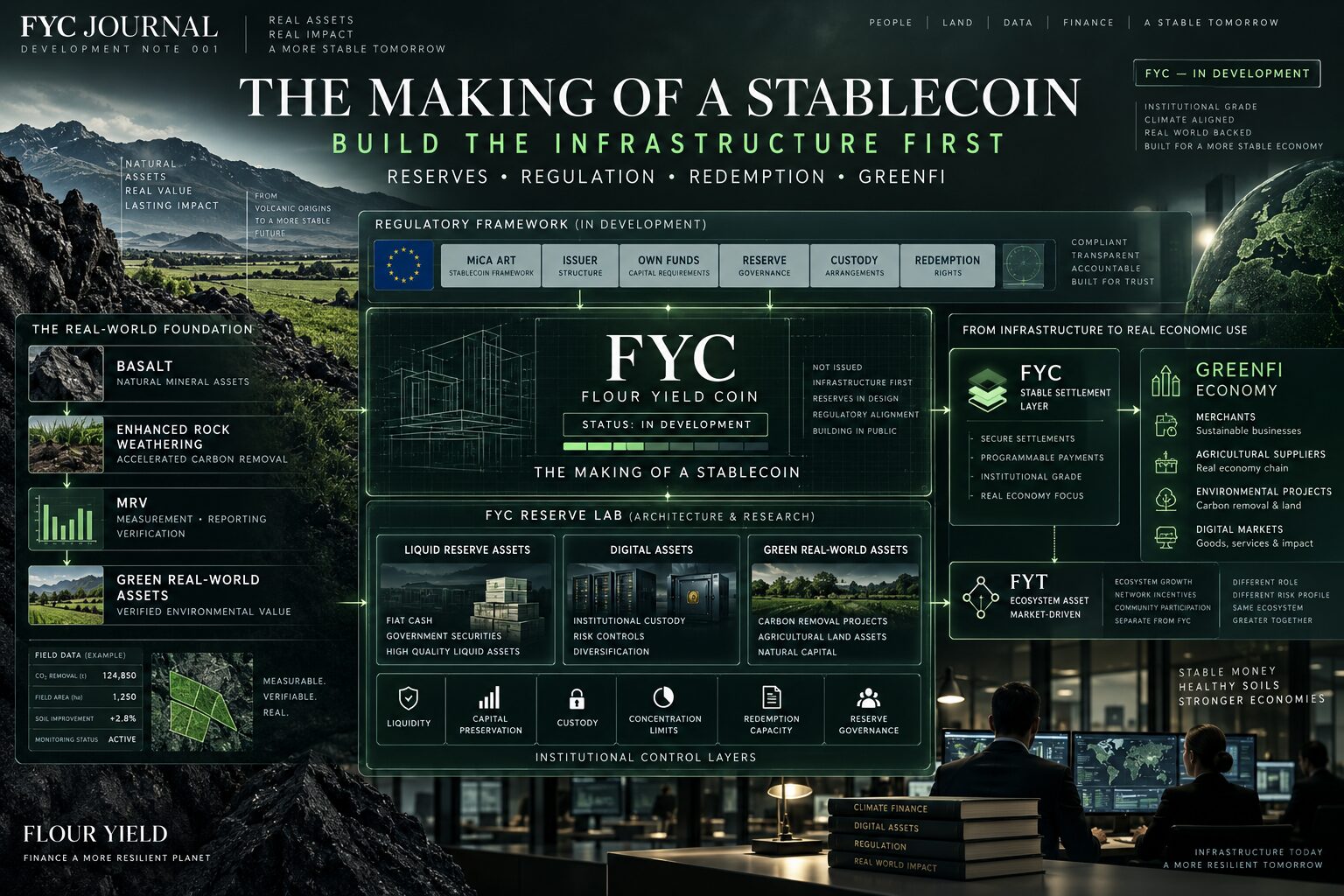
Flour Yield is developing FYC as a separate stable-value settlement layer alongside FYT. This first Development Note explains why the infrastructure, reserve and regulatory architecture come before token issuance.
Development Note 001 · FYC Development
Flour Yield is entering a new phase. The project started with the Flour Yield Token, FYT — a market-driven crypto-asset designed to connect digital markets with regenerative commerce, basalt, environmental applications and the wider Flour Yield ecosystem.
FYT remains that asset (FYT website). But as the GreenFi architecture evolved, a second requirement became increasingly clear: an ecosystem token and a settlement asset are not the same thing.
That insight is the starting point for FYC — the Flour Yield Coin.
FYC is being developed as a separate stable-value, reserve-based settlement and liquidity layer for the Flour Yield ecosystem.
It does not exist yet. And that is precisely why we are launching the FYC Journal now.
Crypto projects often begin with a token.
A smart contract is deployed. A name is chosen. Supply is created. Only afterwards do the harder questions begin:
What should support its value?
Who holds the reserves?
How does redemption work?
Which entity issues it?
What happens during periods of market stress?
Which assets are liquid enough to support redemptions?
How should custody work?
What regulatory framework applies?
For FYC, we want to reverse that sequence.
The infrastructure comes first. The token comes later.
The FYC project therefore starts not with issuance, but with architecture.
That architecture currently includes several interconnected workstreams:
reserve design;
liquidity and redemption;
regulatory structuring;
custody and treasury governance;
digital-asset infrastructure;
real-world green assets;
Measurement, Reporting and Verification;
and the relationship between FYC and the existing FYT ecosystem.
The purpose of this Journal is to document that process.
FYT and FYC are intended to perform fundamentally different jobs.
FYT is the ecosystem asset. Its value is market-driven. It can participate in open digital markets and serve utility, commerce and ecosystem functions.
That freedom also means volatility.
For many applications, volatility is acceptable — and sometimes useful. A market asset should be allowed to discover its own price.
Settlement is different.
A farmer, merchant, supplier, liquidity provider or business counterparty may not want the value of a payment instrument to change materially between invoice and settlement.
GreenFi therefore faces the same structural issue seen elsewhere in digital finance:
market assets create participation and upside; stable assets create settlement and liquidity.
Trying to force both roles into one token creates unnecessary tension.
Our current architecture therefore separates them.
FYT — Flour Yield Token
Market-driven ecosystem and participation layer.
FYC — Flour Yield Coin
Proposed reserve-based settlement and liquidity layer.
The two concepts belong to the same ecosystem, but they are not the same asset.
Holding FYT does not create a claim against a future FYC reserve, and no automatic conversion between FYT and FYC is implied.
The word “stablecoin” sounds simple. The infrastructure behind one is not. A stablecoin is ultimately a balance-sheet and liquidity architecture expressed through a token. Minting and burning are only the visible endpoints.
Behind them sit questions of reserve quality, custody, counterparty exposure, liquidity, asset concentration, valuation, redemption and governance.
Regulation adds another layer. Under a regulated framework, reserve design cannot simply be separated from the issuer, the legal rights of holders or the mechanism through which assets can be redeemed.
This is why we describe FYC as The Making of a Stablecoin rather than presenting it as a completed product.
There are still material questions to answer.
This may become the most important question in the FYC development process. Conventional stablecoins generally focus on highly liquid financial assets. That makes sense. If holders can redeem a token, the issuer needs sufficient liquidity to meet those redemptions.
But Flour Yield is trying to explore a broader question:
Can a stable settlement asset retain strong liquidity while connecting part of its economic architecture to measurable green real-world (RWA) value?
That question is the basis of the FYC Reserve Lab.
The Reserve Lab currently separates the problem into three conceptual layers.
The first responsibility of a reserve is resilience.
Assets in this layer would need to support liquidity, capital preservation and redemption capacity.
Whatever FYC ultimately becomes, this layer cannot be replaced by a green narrative.
Liquidity is infrastructure.
Digital markets are becoming an increasingly important source of liquidity and financial infrastructure.
The FYC project will therefore examine whether selected digital assets could have a controlled role in a broader reserve or treasury architecture.
That analysis must include volatility, concentration, custody, liquidity and regulatory eligibility.
FYT itself may be part of that research.
Research, however, does not mean inclusion.
This is where Flour Yield differs from most stablecoin projects.
The wider Flour Yield ecosystem is already built around real-world environmental activity — particularly basalt, Enhanced Rock Weathering and the measurement of climate and soil impacts.
Basalt is not interesting because it allows us to put the word “green” on a financial product.
It is interesting because it represents something physical, measurable and economically useful.
Enhanced Rock Weathering potentially connects that physical material with carbon removal.
Measurement, Reporting and Verification can connect the physical process with auditable data.
The question for FYC is whether — and how — these forms of real-world environmental value can interact with a stable financial architecture without compromising liquidity, transparency or regulatory compliance.
We do not yet know the final answer.
That is why this is a Reserve Lab rather than a reserve announcement.
FYC is also forcing us to reconsider a common assumption in crypto development: that the product can be designed first and legal structuring added later.
For a stablecoin, that separation does not work.
Regulation affects the architecture itself.
The applicable framework can determine:
who may issue the asset;
what reserve assets may be held;
how those assets must be segregated;
what capital the issuer requires;
how custody is structured;
what rights holders receive;
and how redemption must operate.
We are therefore examining the regulatory pathway at the same time as the reserve and settlement architecture.
One track under consideration is the European MiCA framework for Asset-Referenced Tokens.
Alternative structures and jurisdictions are also being analysed.
No final issuer jurisdiction or regulatory pathway for FYC has been selected.
That uncertainty is not something we intend to hide.
It is part of the development process.
This brings us to the central idea behind the new Flour Yield website and the FYC Journal.
We are building FYC in public.
That does not mean publishing every internal conversation or pretending that every idea deserves equal weight.
It means creating a visible trail between research and decisions.
The process should increasingly look like this:
Question → Research → Journal → Decision → Architecture
Some articles will explore ideas that never become part of FYC.
Some assumptions will change.
Some concepts may prove economically attractive but regulatorily impractical.
Others may appear elegant in theory but fail because they reduce liquidity or create unacceptable complexity.
Those conclusions are valuable.
A development journal that contains only decisions we ultimately keep would not really document development.
The next FYC Journal notes will examine the questions now sitting at the centre of the project.
Why do FYT and FYC need to remain separate?
What should back a GreenFi stablecoin?
What role could basalt, Enhanced Rock Weathering and environmental assets play?
How does MiCA change the economics of stablecoin design?
How should liquidity and redemption shape the reserve before any green assets are considered?
And what can FYC learn from the stablecoin infrastructure already being built across crypto and traditional finance?
The answers may change the architecture.
That is the point.
FYC is not being presented as the finished answer.
It is an attempt to work through the problem openly and systematically.
The token can come later.
First, we build the infrastructure.
This article establishes the current development principle behind Flour Yield Coin:
FYC will be developed as a separate settlement asset from FYT, and reserve, regulatory and redemption architecture will be developed before issuance.
The detailed structure remains under development. References to possible reserve assets, regulatory pathways and future functionality describe current research directions and should not be interpreted as final FYC design decisions.
Flour Yield Coin (FYC) has not been issued. This article documents an ongoing development project and does not constitute an offer, solicitation or invitation to acquire any crypto-asset or financial product. Any future FYC issuance would be subject to the applicable legal and regulatory framework and, where required, regulatory authorisation.
