
Beautiful Plants For Your Interior
Beautiful Plants For Your Interior

The FYC Reserve Lab is not an existing reserve or asset portfolio. It is the research and design framework used to determine what must sit behind FYC legally,
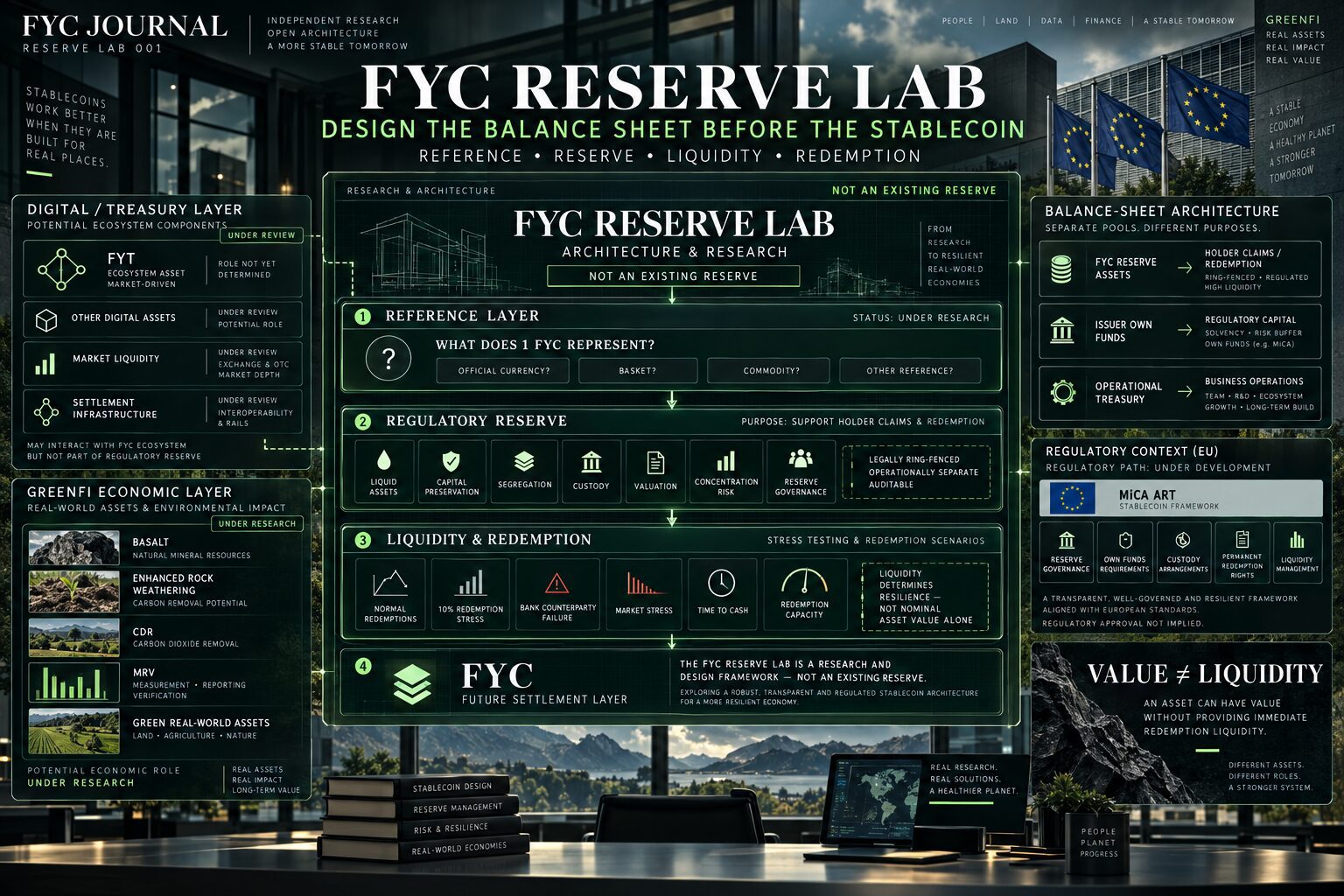
Reserve Lab 001 · FYC Journal
In our first FYC Development Note, we introduced a simple principle:
Build the infrastructure first. Issue the token later.
That immediately creates another question. What infrastructure? For a stablecoin, much of the answer sits behind two words that appear deceptively simple:
the reserve.
We have therefore introduced the FYC Reserve Lab as one of the core workstreams in the development of Flour Yield Coin. But what exactly is a Reserve Lab?
And does it mean that Flour Yield already has a reserve containing cash, FYT, basalt and carbon-removal assets? The answer to the second question is simple:
No.
There is currently no FYC reserve because FYC has not been issued. The FYC Reserve Lab is something different.
It is the research and design framework through which we determine what must sit behind FYC — legally, financially, operationally and economically — before a reserve is constituted and before any FYC can be issued.
That distinction is fundamental.
A stablecoin may look like a token on a blockchain. Economically, however, it is closer to a balance sheet. If somebody holds one unit of a stable asset, there needs to be a credible answer to several questions:
What value is that unit supposed to represent?
What assets stand behind that obligation?
Who owns those assets?
Where are they held?
How quickly can they be converted into cash?
What happens when holders want to redeem?
What happens if many holders want to redeem at the same time?
What happens if one of the reserve assets falls in value?
And, in the case of FYC:
Where does the “GreenFi” element actually belong?
The FYC Reserve Lab exists to work through these questions before we decide what the final FYC architecture should look like. It is therefore better understood as a stablecoin balance-sheet laboratory than as a vault containing assets.
This distinction deserves to be explicit. The FYC Reserve Lab is a development process. A future FYC Reserve would be (a) an actual pool of assets established and (b) managed under the applicable legal and regulatory framework.
Today we have the first. We do not yet have the second. The Lab can therefore examine basalt, carbon-removal assets, FYT, cash, government securities, stablecoins, bank deposits or other assets without implying that any of them will ultimately become reserve assets.
Some may qualify.
Some may serve another function.
Some may prove inappropriate.
And some may be excluded by the regulatory framework we ultimately choose.
That is precisely what the Lab is intended to determine.
This may be the most important conceptual point.
A stablecoin reserve and the value that the stablecoin references are not necessarily the same thing.
Consider two simple examples.
A token might promise:
1 token = EUR 1
Alternatively, a token might seek to maintain its value against a combination of values — for example currencies, commodities or other rights.
Those two designs can lead to very different regulatory architectures.
Under MiCA, a crypto-asset that seeks to maintain a stable value by referencing one official currency is an e-money token.
A crypto-asset that seeks to maintain a stable value by referencing another value, right or combination of values or rights falls, subject to the precise structure, within the asset-referenced-token framework.
So one of the first questions in the FYC Reserve Lab is not:
What assets do we buy?
It is:
What exactly should one FYC represent?
Until that question is answered, it is impossible to design the reserve properly.
This is where our own thinking around the Reserve Lab has become more precise.
When we originally described three possible layers — liquid assets, digital assets and green real-world assets — it was easy to read that as a proposed asset allocation.
For example:
50% cash + 20% digital assets + 30% basalt.
That is not what the Reserve Lab currently means.
Instead, we need to distinguish at least four different functions.
This answers:
What value is FYC trying to keep stable against?
That could theoretically be:
a currency;
a combination of currencies;
a commodity or other value;
a basket of different values;
or another defined reference architecture.
This is not merely a marketing decision. It potentially determines the regulatory category of the token and the nature of the holder’s claim. For FYC, this question remains open.
This is the actual pool of assets that would stand behind the liabilities created by issued FYC. Here the priorities are very different from the GreenFi narrative.
They include:
liquidity;
capital preservation;
valuation;
segregation;
custody;
concentration risk;
and above all:
redemption capacity.
If FYC were structured as a MiCA Asset-Referenced Token, the issuer would have to constitute and continuously maintain a reserve of assets. The reserve must cover the risks arising from the referenced assets and the liquidity risks associated with holders’ permanent redemption rights. It must also be legally and operationally segregated from the issuer’s own estate.
That tells us something important.
The regulatory reserve does not exist primarily to tell a compelling investment story.
It exists to honour the liability represented by FYC.
Not every economically useful asset necessarily has to belong to the regulatory reserve. The wider FYC system could potentially require operational liquidity, market-making arrangements, collateral, settlement accounts or other treasury infrastructure outside the ring-fenced reserve.
This is particularly relevant when we examine digital assets. For example, the Reserve Lab may investigate whether FYT could play some role in the wider FYC economy. But that does not automatically mean:
FYT backs FYC.
There are several fundamentally different possibilities.
FYT could theoretically be:
a referenced asset;
a reserve asset, if legally and prudentially permissible within the eventual structure;
a treasury asset outside the regulatory reserve;
a liquidity or ecosystem asset;
or simply an independent token with no balance-sheet role in FYC at all.
The Reserve Lab exists precisely to distinguish between these possibilities.
Researching an asset is not the same as selecting it.
This may ultimately be the most distinctive part of FYC.
Flour Yield originates in a real-world environmental thesis built around basalt, Enhanced Rock Weathering (ERW), regenerative agriculture and measurable environmental impacts.
Basalt can potentially improve soils while participating in Enhanced Rock Weathering processes that remove atmospheric carbon dioxide. MRV can turn physical deployment and environmental outcomes into measurable data.
That physical foundation already exists within the broader Flour Yield thesis. But another question follows:
Does that mean basalt should sit directly inside the regulatory FYC reserve?
Not necessarily. This is one of the questions the Reserve Lab must answer.
Basalt, ERW projects or verified carbon-removal assets could theoretically interact with FYC in several different ways.
They might become part of a reference architecture.
They might, depending on the final legal design, qualify for some form of reserve treatment.
They might sit outside the reserve but form part of the economic ecosystem supporting FYC demand.
They might generate revenues that strengthen the broader GreenFi infrastructure.
Or they might simply provide the real-world environmental foundation of the Flour Yield ecosystem without being part of FYC’s balance sheet at all.
The Flour Yield Basalt Dossier already establishes basalt, ERW, soil effects and MRV as core elements of the project’s real-world environmental thesis. That does not by itself determine their appropriate role in a future regulated stablecoin architecture.
That distinction matters.
GreenFi does not require us to force green assets into the reserve.
It requires us to understand where they add genuine economic and environmental value without weakening the financial architecture.
Suppose FYC eventually has one million units in circulation. Now suppose holders suddenly want to redeem 200,000 units. The reserve may look extremely valuable on paper. But that is not enough. The issuer must be able to access the assets needed to honour those redemptions.
A million euros of liquid securities is economically very different from a million euros of basalt sitting at a quarry.
Both may have value.
Only one can normally be turned into settlement liquidity almost immediately.
This is why the Reserve Lab must distinguish between:
value and liquidity.
A stablecoin can fail while technically owning sufficient assets if those assets cannot be liquidated quickly enough.
MiCA reflects precisely this concern. Its ART rules require the reserve to address the liquidity risks created by permanent redemption rights, and the EBA’s liquidity-management framework is explicitly designed to ensure that reserve assets maintain a resilient liquidity profile capable of meeting redemption requests, including under stress.
For FYC, this produces a simple design rule:
Green assets can add economic meaning. They cannot substitute for redemption liquidity.
Stablecoins are often discussed in terms of backing. The Reserve Lab should probably focus at least as much on redemption.
The question is not only:
What do we own?
It is:
What happens when holders want their money back?
Under the MiCA ART framework, holders have a permanent right of redemption. The issuer must establish detailed procedures for redemption and must be able to redeem by paying the relevant amount in funds or, depending on the token structure, by delivering referenced assets.
That makes redemption the bridge between the token and the balance sheet.
A useful FYC Reserve Lab therefore needs to model scenarios such as:
Normal daily redemptions.
A sudden 10% redemption wave.
Loss of a banking counterparty.
A sharp fall in the value of a reserve asset.
Illiquidity in a digital asset.
A delay in selling a physical asset.
A custodian failure.
A market-wide crypto stress event.
Only after asking those questions can we understand whether a proposed reserve is actually resilient.
This also explains why the common phrase “100% backed” tells us surprisingly little.
Imagine two stablecoins.
Stablecoin A has EUR 100 million of liabilities and EUR 100 million of cash and very short-term liquid instruments.
Stablecoin B also has EUR 100 million of liabilities and EUR 100 million of assets — but those assets consist largely of illiquid commodities, volatile tokens and long-duration investments.
Both could theoretically call themselves fully backed.
They are not financially equivalent.
The Reserve Lab therefore needs to look beyond the headline reserve ratio.
We need to examine:
asset quality;
liquidity;
duration;
volatility;
counterparty risk;
custody;
concentration;
and time to cash.
For a stablecoin, the structure of the assets can matter as much as their nominal value.
The digital-asset layer deserves particular attention because it is easy to misunderstand.
MiCA itself contemplates that crypto-assets can, depending on the structure, be included among reserve assets and establishes custody rules for such assets. At the same time, where reserve assets are invested, Article 38 imposes a highly conservative standard: those investments must be highly liquid financial instruments with minimal market, credit and concentration risk and capable of rapid liquidation with minimal price impact.
That means the question cannot simply be:
Would we like FYT or another digital asset in the reserve?
The correct questions are:
What function would it perform?
What legal category would it occupy?
How volatile is it?
How liquid is it under stress?
How would it be valued?
Who would custody it?
Would the concentration be acceptable?
Does its inclusion improve or weaken FYC’s stability?
And does the regulatory framework permit the intended treatment?
That is the kind of analysis the Reserve Lab is meant to perform.
There is another pool of capital that should not be confused with the reserve:
the issuer’s own funds.
If FYC were issued as an ART under MiCA, the issuer would itself need regulatory capital. MiCA sets the minimum at the highest of EUR 350,000, 2% of the average reserve assets or one quarter of the previous year’s fixed overheads, with the possibility of higher requirements depending on risk and stress testing.
So we can already distinguish three different balance-sheet concepts:
FYC reserve assets
→ assets maintained for the token architecture and holder claims.
Issuer own funds
→ regulatory capital protecting the issuer.
Operational treasury
→ resources used to operate the business.
They are not interchangeable.
The Reserve Lab needs to model all three.
Our current conceptual architecture can therefore be expressed more accurately as follows:
FYC STABILITY OBJECTIVE
↓
REFERENCE LAYER
What does FYC represent?
↓
REGULATORY RESERVE
Liquidity
Capital preservation
Custody
Segregation
Valuation
Redemption capacity
↓
FYC
Stable settlement layer
Alongside this core sit two additional research layers:
DIGITAL / TREASURY LAYER
FYT
Other digital assets
Market liquidity
Settlement infrastructure
and
GREENFI ECONOMIC LAYER
Basalt
ERW
CDR
MRV
Green real-world assets
The Reserve Lab asks where — if anywhere — each of those components belongs in the final architecture.
That is much more precise than simply describing three buckets of assets.
We can now give it a formal working definition.
The FYC Reserve Lab is the research and design framework used to determine the reference value, reserve composition, liquidity structure, custody model, redemption architecture and relationship between financial, digital and green real-world assets required for a resilient future FYC.
It is not:
a fund;
a portfolio;
an existing reserve;
a promise of future asset allocation;
or a statement that FYT, basalt or carbon assets will back FYC.
It is where those questions are tested.
Ultimately the Reserve Lab should produce something much more concrete than research papers.
Before FYC could be launched, it should be possible to answer clearly:
1. What does one FYC reference?
2. What legal claim does an FYC holder have?
3. What assets constitute the regulatory reserve?
4. What percentage of the reserve must remain immediately liquid?
5. Where are those assets held?
6. How are they valued?
7. How does minting change the reserve?
8. How does redemption change the reserve?
9. What happens in a stress scenario?
10. What role, if any, do FYT and other digital assets play?
11. What role do basalt, ERW and other GreenFi assets play?
12. Which assets sit inside the reserve and which belong outside it?
When we can answer those questions coherently, the Reserve Lab will have done its job.
There is one final principle we think should guide this work.
FYC should not sacrifice financial resilience merely to maximise the percentage of assets that can be labelled green.
That would reverse the logic of the project.
A stable settlement asset must first be stable.
A redemption mechanism must first be redeemable.
A reserve must first be liquid enough to perform its function.
The GreenFi challenge is therefore more interesting:
Can we build conventional financial resilience at the core while progressively connecting the architecture to measurable environmental value?
That may mean that the most liquid part of the reserve looks relatively conventional.
It may mean that green real-world assets play a different economic role.
Or it may ultimately produce a structure we have not yet considered.
The Reserve Lab exists because we do not want to decide the answer in advance.
The next Reserve Lab work should now move from terminology to architecture.
We need to examine the central question:
What should one FYC actually reference?
Only then can we meaningfully decide what belongs in the reserve.
After that come the next questions:
How much immediate liquidity would FYC require?
Could digital assets have a prudent role?
Where can basalt and environmental assets genuinely add value?
How should redemption work?
And which regulatory architecture best supports the resulting model?
Those questions will form the next stages of the FYC Reserve Lab.
We are not filling a reserve.
We are designing the balance sheet that must exist before the stablecoin can.
This Reserve Lab Note sharpens the meaning of the term FYC Reserve Lab.
The Reserve Lab is not an existing FYC reserve and the asset categories discussed within it are not proposed allocations.
Its purpose is to determine the appropriate role of four distinct components:
the reference layer, the regulatory reserve, the digital/treasury layer and the GreenFi economic layer.
A material implication follows:
Basalt, FYT or other GreenFi and digital assets should not be described as future FYC reserve assets unless and until the Reserve Lab determines their precise legal, financial and regulatory role.
The immediate next design question is therefore not “what percentage of FYC should be backed by basalt?”
It is:
What should one FYC reference — and what holder claim should follow from that reference?
Flour Yield Coin (FYC) has not been issued. The FYC Reserve Lab is a research and development framework and does not constitute an investment fund, reserve portfolio, asset allocation or promise concerning the future composition of an FYC reserve.
References to potential assets, regulatory categories and reserve structures are exploratory and may change materially. Any future issuance of FYC would be subject to the applicable legal and regulatory framework and, where required, regulatory authorisation.
