
Beautiful Plants For Your Interior
Beautiful Plants For Your Interior

FYC aims to become an RWA-based stable settlement asset linked to a concrete real-world resource. This report examines how the economic value of the Albanian basalt mine could be translated into a legally robust, measurable and financially resilient digital asset architecture.
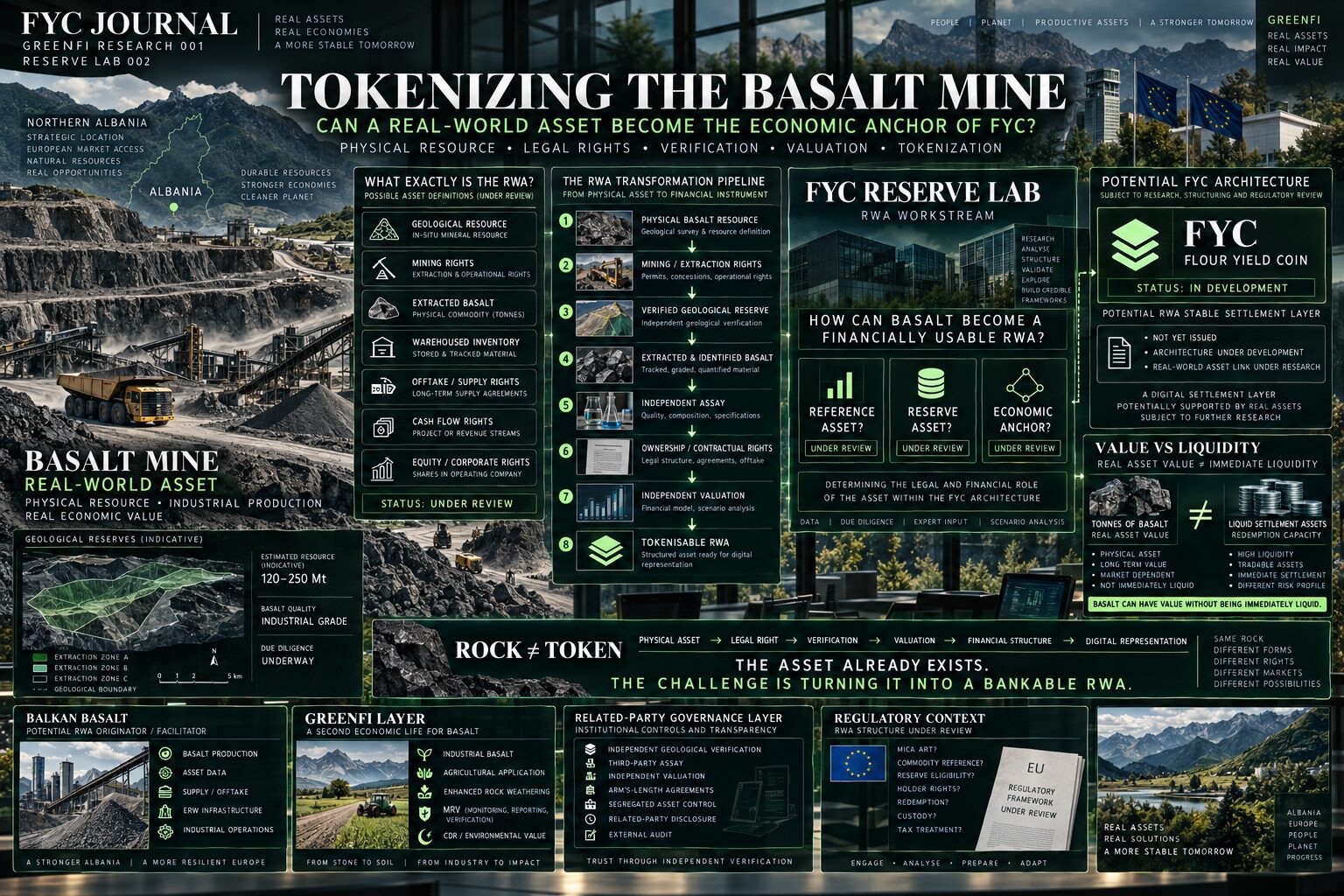
GreenFi Research 001 · Reserve Lab 002
The first two FYC Journal notes were intentionally abstract. We started by explaining why Flour Yield is developing FYC as a separate stable settlement asset alongside FYT. Then we introduced the FYC Reserve Lab and asked what actually needs to sit behind a stablecoin before it can be issued.
Now it is time to become concrete.
Flour Yield does not need to invent a hypothetical real-world asset for FYC.
The asset already exists.
It is basalt. More specifically, it is the economic value connected to the operating basalt mine in Albania that already forms part of the wider Flour Yield ecosystem. This changes the FYC question fundamentally.
We are not asking:
Can we create another stablecoin and add some green assets to it?
We are asking:
Can the economic value of a real industrial basalt resource be translated into a legally robust, measurable and financially resilient digital asset architecture?
That is the RWA challenge behind FYC.
And that is now one of the central tasks of the FYC Reserve Lab.
Balkan Basalt operates a basalt mining site in northern Albania through its Albanian operating company, Balkan Basalt Shpk. According to Balkan Basalt, the site covers approximately 47 hectares, contains an estimated 220 million tonnes of basalt and currently produces around 360,000 tonnes annually, with potential production expansion beyond one million tonnes per year. The company states that its mining permits run through 2050.
There is also an official Albanian public record behind the mining operation.
A 2017 decision of the Albanian Council of Ministers specifically refers to Balkan Basalt Shpk and 44.7 hectares at the Blinisht mining object in the Spaç area being used for exploitation of basalt mineral. Importantly for any future RWA analysis, that decision also states that the relevant forest and pasture areas remain public property of the Albanian state while being designated for mining activity.
That distinction will matter.
The economic asset connected with the mine cannot simply be described as “ownership of 220 million tonnes of rock underground.”
Mining rights, land rights, extraction rights, extracted material, inventory and contractual claims are different legal concepts.
A blockchain does not remove those distinctions.
Tokenization makes them more important.
FYC is intended to become a Real-World-Asset stablecoin.
That is a more specific ambition than simply creating a “green stablecoin.”
A green stablecoin could theoretically hold conventional financial reserves and use part of its profits to finance environmental projects.
That may be useful.
But it is not the core Flour Yield thesis.
The stronger idea behind FYC is that a measurable real-world productive asset can become part of the economic architecture connecting physical value with digital settlement.
In our case, that asset is not a theoretical portfolio assembled after the token has been designed.
It originates in an existing industrial operation.
There is rock.
There is a mine.
There are mining rights.
There is production.
There are customers.
There are logistics.
There is an existing market for basalt.
There is potentially another emerging market for basalt through Enhanced Rock Weathering.
And there is already a contractual relationship between the Flour Yield ecosystem and Balkan Basalt.
The current FYT documentation describes a Purchase & Supply Agreement under which one million tonnes of basalt are reserved on consignment for Insela UAB, while carefully clarifying that the arrangement does not create asset backing, collateralisation or redemption rights for FYT holders.
That distinction was deliberate.
FYT is a market-driven ecosystem token.
It was specifically structured so that the basalt relationship did not turn FYT into a stable or asset-referenced token.
FYC asks the opposite question.
What would we have to change if we actually wanted the real-world asset relationship to matter financially?
That is a much more difficult problem.
It is also a much more interesting one.
The phrase “tokenizing the basalt mine” is useful because everybody intuitively understands it.
But technically it is incomplete.
A physical mine cannot simply be converted into tokens.
What can be tokenized are legally identifiable rights associated with economic value.
This is the core RWA principle.
Before any blockchain layer becomes relevant, we therefore need to determine what the underlying asset actually is.
Is it the basalt still underground?
Is it the mining concession or extraction right?
Is it extracted basalt inventory?
Is it a contractual right to receive basalt?
Is it an offtake agreement?
Is it a security interest over inventory?
Is it equity in the mining company?
Is it a claim against future basalt sales?
Is it a right to revenues generated through Enhanced Rock Weathering or carbon removal?
Or is the most robust solution a combination of several of these rights?
These are fundamentally different assets.
They have different ownership structures.
Different risks.
Different liquidity.
Different valuation methods.
And potentially very different regulatory treatment.
So the first task of mine tokenization is not technical.
It is legal and economic:
Identify exactly which enforceable right represents the RWA.
Only then does tokenization begin.
This creates a chain that the FYC Reserve Lab now needs to investigate.
At one end sits the physical resource:
ALBANIAN BASALT MINE
From there we move through several layers:
Mining and extraction rights
↓
Verified geological resource
↓
Extractable basalt
↓
Extracted and identified basalt inventory
↓
Independent assay and quality verification
↓
Ownership, custody or contractual delivery rights
↓
Independent valuation
↓
Tokenisable economic right
↓
Potential FYC RWA architecture
Every step matters.
A geological estimate is not the same thing as inventory.
Inventory is not the same thing as legal title.
Legal title is not the same thing as liquidity.
And liquidity is not the same thing as stablecoin redemption capacity.
This is why RWA tokenization is fundamentally different from issuing an ordinary crypto token.
The smart contract is probably the easiest part.
At this stage, we should therefore be precise.
We are not yet declaring that the entire Albanian mine is the FYC reserve.
We are saying something more meaningful:
The Albanian basalt mine is the primary real-world economic asset that the FYC Reserve Lab will investigate for integration into the future FYC architecture.
That investigation needs to determine which rights associated with the mine are suitable for financial structuring.
One useful way to think about the asset is as several concentric layers.
At the broadest level sits the geological resource — the basalt that exists physically in the mountain.
Closer to financial reality sit the mining rights that allow that resource to be extracted.
Closer still is extracted basalt, where quantity, location, quality and title can potentially be verified much more precisely.
Then come contractual rights — for example rights to receive specific quantities of basalt under an offtake or supply arrangement.
Finally, there are economic cash flows generated through ordinary basalt sales and potentially through ERW and carbon-removal applications.
The FYC Reserve Lab needs to determine where in this chain the strongest tokenisable RWA actually exists.
It may not be the point we initially expect.
This leads to an important distinction.
An economic anchor is not necessarily identical to a regulatory reserve asset.
The Albanian basalt mine can be central to the economics and identity of FYC even if the final regulated reserve also requires substantial liquid financial assets.
That may ultimately be the most important insight of the entire RWA design.
Suppose a defined quantity of independently verified basalt has a substantial economic value.
That value is real.
But if 20% of FYC holders request redemption tomorrow morning, selling thousands of tonnes of basalt within hours may be impractical.
This brings us back to the principle established in Reserve Lab 001:
VALUE ≠ LIQUIDITY
Basalt can be highly valuable while remaining less liquid than cash or short-term financial instruments.
A resilient stablecoin needs to understand both.
Under MiCA’s ART framework, the reserve has to be structured to cover the risks of the referenced assets and the liquidity risks created by permanent redemption rights. Reserve assets must be legally and operationally segregated, the issuer must have prompt access to them for redemption, and holders have an ongoing right to redeem.
That does not tell us that basalt cannot play a role.
It tells us what the Reserve Lab has to solve.
The Reserve Lab is no longer an abstract exercise in choosing asset classes.
It now has a concrete RWA mission:
Determine how legally enforceable economic rights arising from the Albanian basalt mine can be identified, verified, valued, segregated, tokenized and integrated into a resilient FYC architecture without compromising liquidity and redemption.
That task contains several different problems.
We need to identify the legal asset.
We need to establish who owns or controls it.
We need independent geological and technical verification.
We need quality measurement.
We need a valuation methodology.
We need to determine whether the asset can be segregated.
We need to determine how custody works for a physical commodity or contractual right.
We need to understand transferability.
We need to understand how quickly the asset can be monetised.
And then we need to determine its appropriate place in the FYC architecture.
The blockchain comes after these questions, not before them.
At this point, we see at least three broad architectures worth testing.
This would be the most direct expression of the RWA thesis.
FYC would seek to maintain a stable value by reference to a defined quantity or value of basalt.
Conceptually, something such as:
1 FYC = reference value of X kilograms of defined basalt
The details would be critical.
Which basalt specification?
At what stage of production?
Which location?
Which market price?
Who publishes that price?
How often is it updated?
What does the holder receive upon redemption?
These questions would have to be resolved before such a model could be viable.
But conceptually it would make FYC a genuine commodity-referenced digital settlement asset rather than a conventional fiat stablecoin with a green label.
A second possibility would combine a basalt-linked economic component with highly liquid financial assets.
In that model, the physical RWA provides part of the economic anchor while a liquid reserve layer provides redemption resilience.
This could potentially separate two functions:
RWA value
and
settlement liquidity.
The advantage is obvious.
FYC could retain a meaningful connection to a real productive asset without pretending that basalt itself behaves like cash.
The challenge would be designing the legal relationship between the reference value, reserve composition and holder rights.
That is precisely a Reserve Lab question.
A third possibility is more conservative.
The FYC core reserve could remain predominantly liquid while the basalt mine acts as the economic foundation of the broader GreenFi ecosystem.
Basalt sales, ERW projects, environmental assets and associated revenues could then support the growth and capitalisation of the wider FYC infrastructure without necessarily becoming direct reserve assets.
This would create a weaker form of direct RWA backing, but potentially a simpler stablecoin architecture.
At this stage, the Reserve Lab should not choose between these models based on narrative appeal.
It should test them.
This RWA approach also changes how we should think about Balkan Basalt.
In the FYT architecture, Balkan Basalt has primarily been described as the strategic basalt and RWA partner.
For FYC, the potential role is broader.
Balkan Basalt could become the RWA originator.
The mine operator is the point from which the physical asset, production data, geological information, inventory and commercial rights originate.
It could also become a facilitator of verification, allowing independent technical and financial experts to validate the relevant asset.
It could become an offtake counterparty, helping establish real market demand and pricing.
It could become an ERW facilitator, connecting basalt production to carbon-removal applications.
And the shareholders and investors behind Balkan Basalt could become strategically important participants in the FYC project itself.
There is an intuitive economic logic to this.
If FYC is attempting to transform part of the mine’s economic value into a digital financial architecture, the owners and investors closest to that asset have a strong incentive to help make that infrastructure credible.
Successful RWA tokenization could potentially open new forms of liquidity, financing, distribution and environmental monetisation around the underlying asset.
That makes Balkan Basalt and its investor base natural candidates for strategic participation in FYC.
But it also creates a governance challenge.
The closer the relationship between the asset provider, its investors and the FYC ecosystem becomes, the more important independent governance becomes.
Imagine a structure in which the same economic group:
provides the asset;
values the asset;
controls the issuer;
custodies the asset;
and determines the price used by the stablecoin.
Even if every participant acts properly, such a structure would be difficult for outsiders to trust.
A credible RWA architecture therefore needs to separate economic participation from independent verification.
For the basalt asset, this may eventually require independent geological verification, external assays, independent valuation, transparent title or contractual documentation, arm’s-length transactions, clearly documented related-party relationships, independent reserve audits and potentially independent governance over material reserve decisions.
The goal is not to remove Balkan Basalt from the architecture.
Quite the opposite.
The goal is to make its role sufficiently transparent and verifiable that the market does not need to rely solely on the word of either Balkan Basalt or Flour Yield.
That is how a related ecosystem asset becomes an institutional RWA.
This is also where technology can eventually become useful.
Once the legal asset has been identified, physical and commercial information can increasingly be connected to digital records.
A future RWA data stack might include:
geological reports;
mining permit data;
GPS-defined extraction areas;
production records;
batch identification;
laboratory assays;
warehouse or stockpile records;
transport documentation;
sales transactions;
market pricing;
ERW deployment;
and MRV results.
Cryptographic hashes, digital signatures and blockchain records can help create an immutable provenance trail.
But they cannot create ownership where ownership does not exist.
They cannot turn a mining permit into title to the land.
They cannot transform an estimate into inventory.
And they cannot transform an illiquid physical asset into cash.
Technology can prove data.
Legal architecture must prove rights.
That distinction is fundamental to serious RWA tokenization.
There is another reason basalt is interesting for Flour Yield beyond its physical value.
The asset potentially has two economic lives.
The first is conventional.
Basalt is an industrial commodity used in infrastructure and other commercial applications.
The second is emerging.
Finely processed basalt can be used in agriculture and Enhanced Rock Weathering, where it may contribute to soil remineralisation and atmospheric carbon removal.
The Flour Yield Basalt Dossier already describes this intersection between physical mineral value, agriculture, ERW and MRV.
That creates a potentially unusual RWA:
a productive industrial commodity with an additional climate-finance pathway.
A tonne of basalt is therefore not interesting merely because it sits underground.
Its economic relevance comes from what can be done with it.
Extract it.
Process it.
Sell it.
Apply it.
Measure it.
And potentially generate additional environmental value from its deployment.
That multi-layer utility is part of what makes basalt relevant to the GreenFi thesis.
This is perhaps the most important strategic distinction.
There are many ways to create a stablecoin.
One can choose a currency reference, deposit cash, buy liquid securities and issue tokens.
That may create excellent payment infrastructure.
But it would not by itself explain why Flour Yield should exist.
FYC needs a stronger reason.
The reason is not that blockchain technology is fashionable.
And it is not that “green” is a useful marketing category.
The reason is that Flour Yield sits at an unusual intersection:
a substantial physical resource;
an operating industrial business;
regenerative agriculture;
carbon-removal potential;
digital assets;
and financial infrastructure.
FYC is the attempt to connect these worlds.
That is why we describe it as an RWA stablecoin project.
The real-world asset is not an afterthought.
It is the starting point.
If the RWA architecture works, the objective is not merely to create a digital representation of basalt.
The greater opportunity is to make previously difficult-to-financialise economic value more transparent and usable.
A successful structure could potentially create better visibility into the physical asset.
It could connect verified real-world value to digital settlement.
It could create new financing mechanisms around inventory, production or offtake.
It could connect environmental performance with financial data.
And it could allow the economic value originating in a mine in Albania to participate in global digital financial infrastructure.
That would be genuine RWA tokenization.
Not:
rock → token.
But:
physical asset → legal right → verification → valuation → financial structure → digital representation → liquidity and settlement.
That is the chain FYC needs to build.
The FYC Reserve Lab now has a concrete workstream.
It needs to answer twelve questions:
Those questions are not secondary legal details.
They are the design of FYC.
The first FYC Journal article asked why we need a second asset alongside FYT.
The second asked what a Reserve Lab actually does.
This third note gives the Reserve Lab its first concrete assignment.
Tokenize the economic value of the basalt mine — properly.
Not by declaring that every tonne underground backs a token.
Not by publishing a geological number and multiplying it by a retail price.
Not by putting a mining document on-chain.
And not by assuming that asset value automatically creates stablecoin liquidity.
The task is more demanding.
We need to identify a legally enforceable RWA.
Verify it independently.
Value it credibly.
Determine where it belongs in the FYC balance sheet.
Build liquidity around it.
Create appropriate governance.
And then determine what form of regulated digital asset can emerge from that architecture.
If we can solve those problems, FYC could become something materially different from another fiat stablecoin.
It could become a bridge between a physical European resource and programmable digital settlement.
That is the challenge.
And increasingly, that is the purpose of the FYC Reserve Lab.
This Research Note establishes the Albanian basalt mine and the economic rights arising from it as the primary real-world asset to be investigated within the FYC Reserve Lab.
It does not establish that the mine, its geological reserves, FYT, extracted basalt or any specific contractual right already constitutes an FYC reserve asset.
The development objective is now more precise:
FYC aims to become an RWA-based stable settlement asset whose architecture is meaningfully connected to a concrete real-world asset rather than merely carrying a GreenFi label.
The next Reserve Lab task is therefore to identify which legally enforceable right arising from the Balkan Basalt mine can most credibly serve as the tokenisable RWA, and then determine whether that asset should function as:
the FYC reference asset,
part of the regulatory reserve,
a separate economic anchor,
or some combination of these functions.
The appropriate legal, valuation, custody, liquidity and regulatory structure remains to be determined through the FYC Reserve Lab.
Flour Yield Coin (FYC) has not been issued.
References to the Balkan Basalt mine, basalt resources, mining rights, supply rights, future tokenization, reserve structures or potential FYC relationships describe an ongoing research and development process. They do not constitute a representation that any specific mine, mineral resource, asset, right or quantity of basalt currently backs FYC or will necessarily do so in the future.
Any future RWA or reserve structure would require appropriate legal verification, asset valuation, contractual documentation, governance, custody and regulatory analysis. Any future issuance of FYC would be subject to the applicable legal and regulatory framework and, where required, regulatory authorisation.
