Beautiful Plants For Your Interior
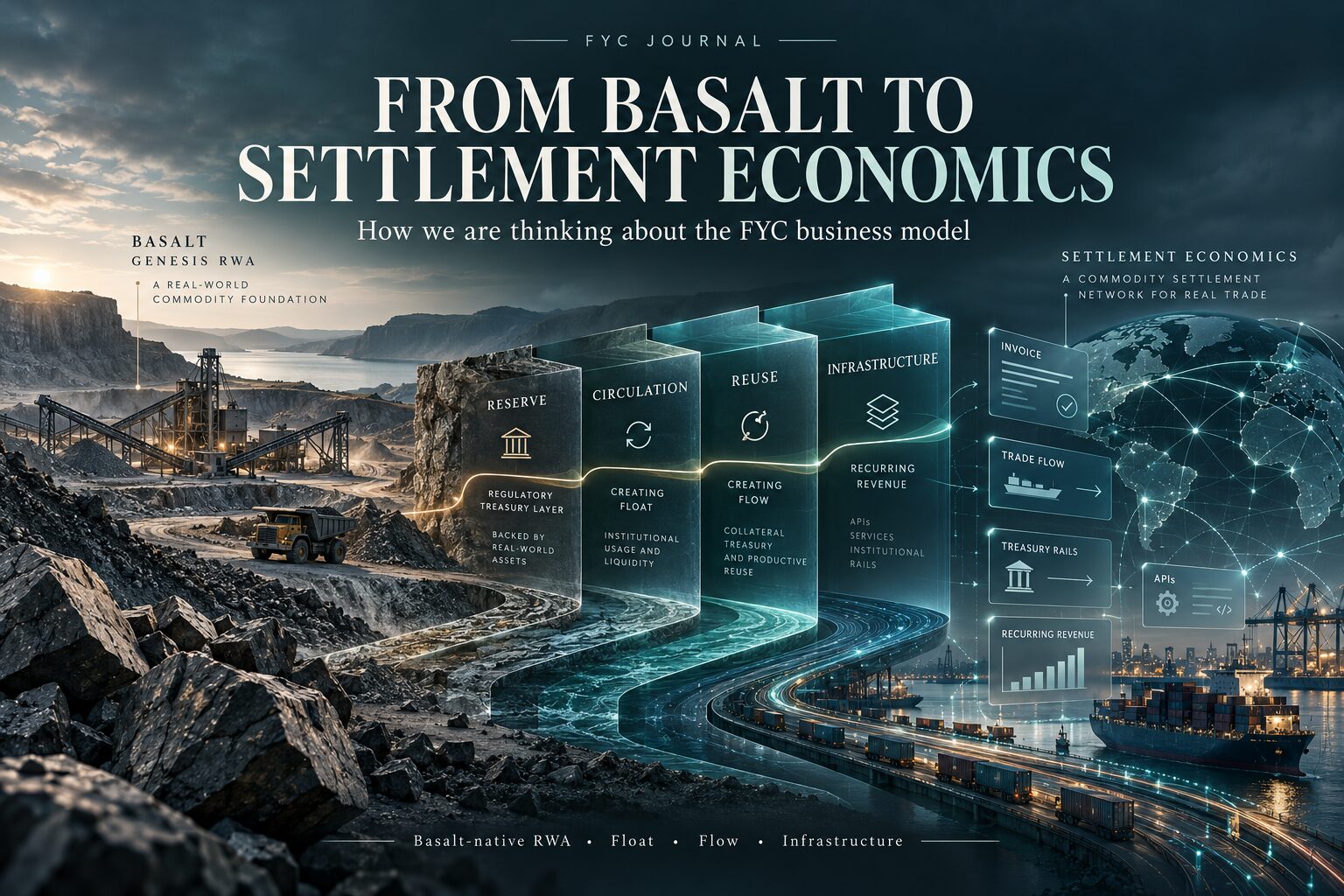
FYC is evolving from a simple basalt-backed stablecoin idea into a broader settlement-network model. This article explains the emerging architecture around the regulatory reserve, basalt as Genesis RWA, transaction reuse and recurring enterprise revenue.
FYC Journal | The Making of a Stablecoin
When we started exploring the concept of FYC — Flour Yield Coin, one of the most obvious questions was also one of the most important:
How could FYC actually become a sustainable business?
At first sight, the economics of major stablecoin issuers appear relatively straightforward. Stablecoins are issued against incoming funds, those funds form the reserve, and eligible reserve assets may generate income. At sufficient scale, the reserve itself can therefore become a significant economic engine.
But FYC started from a different idea.
Our original thinking was strongly connected to basalt as a real-world asset and to the large basalt resource operated by our project partner Balkan Basalt in Albania.
That immediately creates a different question:
If basalt is part of the economic foundation of FYC, but basalt itself does not generate predictable financial yield simply by sitting in a warehouse or mine, where does the sustainable FYC revenue model come from?
That question has led us to rethink the architecture.
And the result is increasingly interesting.
Our current working model separates several roles that were previously easy to mix together.
Basalt can be extremely important for FYC without having to perform every function of the financial reserve.
In our existing Settlement, Distribution and Liquidity Strategy, we already distinguish between the liquidity required for issuance and redemption and a separate strategic RWA layer that could contain basalt rights, inventory or receivables. FYC_Settlement_Distribution_and…
This distinction is becoming central to our thinking.
Today, we increasingly see basalt as:
But that does not automatically mean that physical basalt must become the principal liquid redemption asset.
Our current working proposition can therefore be expressed more clearly:
Basalt creates the market.
Circulation creates the float.
Reuse creates the flow.
Infrastructure creates recurring revenue.
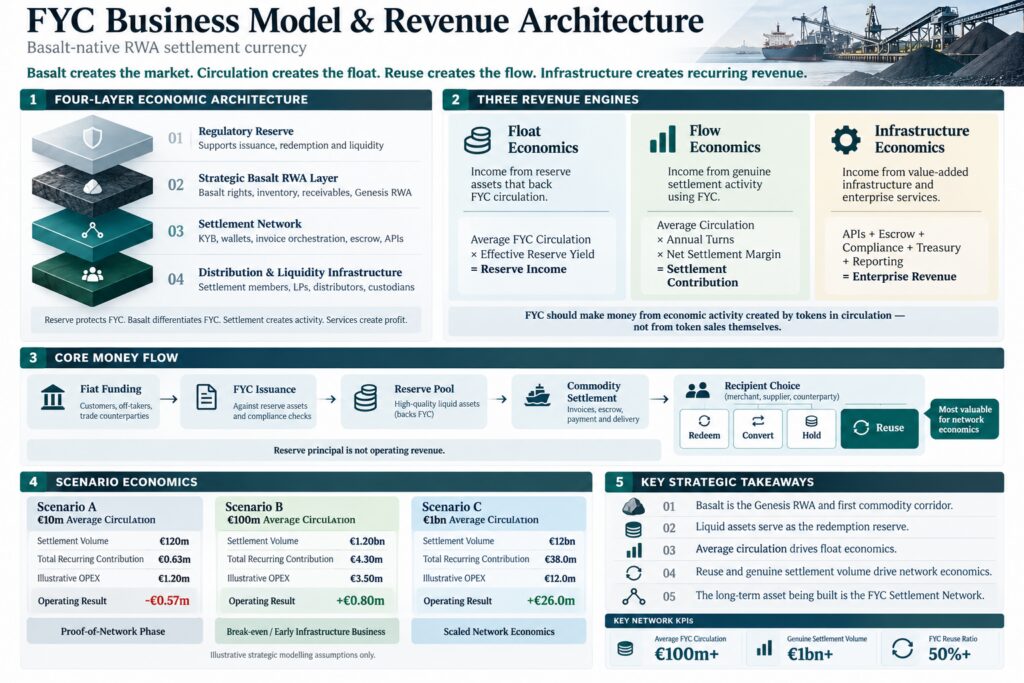
The current working architecture separates the regulatory reserve, the strategic basalt RWA layer, the settlement network and the distribution/liquidity infrastructure.
The emerging FYC business model consists of four distinct economic layers.
When FYC is issued against incoming funds, those funds are not revenue.
They support the FYC liability and must remain available within the applicable reserve and redemption architecture.
In simple terms:
EUR 1 million funding → EUR 1 million reserve assets → 1 million FYC issued
The EUR 1 million is not profit.
This sounds obvious, but it is fundamental to understanding stablecoin economics.
The reserve may generate permitted income, but the reserve principal itself belongs to the financial architecture supporting the token.
Separate from that financial reserve, we are exploring a strategic basalt layer.
Potential components could eventually include:
The important point is that these assets do not automatically have to become the liquid redemption reserve.
Our settlement strategy already describes basalt as the genesis commodity, first source of invoices, strategic economic support asset and potential reserve component — while stressing that these functions are different from one another. FYC_Settlement_Distribution_and…
This leads us toward the term:
rather than simply:
The distinction matters.
Once the layers are separated, the economics become much easier to understand.
We currently see three potential recurring revenue engines for FYC.
The first is created by the amount of FYC that remains in circulation.
If companies acquire FYC for settlement and maintain balances within the network, the issuer has a corresponding reserve base.
Subject to the final legal and reserve architecture, eligible portions of that reserve may generate permitted income.
Conceptually:
Average FYC Circulation × Effective Reserve Yield = Reserve Income
This resembles part of the economics behind conventional stablecoins.
But we do not believe FYC should depend on this alone.
Our existing strategy deliberately requires the commercial model to remain assessable even if reserve income is assumed to be zero. FYC_Settlement_Distribution_and…
That is an important discipline.
Interest rates change. Reserve rules change. Yield should improve the business model — not be the only reason the business works.
This is where FYC becomes more interesting.
Imagine EUR 10 million of FYC circulating in the network.
If those tokens are used only once per year, they generate roughly EUR 10 million of settlement activity.
But if the same circulating FYC is used twelve times during the year:
EUR 10 million circulation × 12 turns = EUR 120 million settlement volume.
Nothing requires EUR 120 million of new tokens to be issued.
The same settlement asset is being reused.
Consider a simplified chain:
Importer → Balkan Basalt → Logistics Provider → Processor → Distributor → Agricultural Buyer
The first transaction may bring FYC into circulation.
The subsequent transactions make the existing FYC economically productive.
This is why we increasingly view the FYC Reuse Ratio as one of the project’s most important future KPIs.
Our current strategy already defines reuse as FYC received through real trade and subsequently used for another verified commercial obligation, rather than simply counting exchange turnover or internal transfers. FYC_Settlement_Distribution_and…
The distinction can be summarised in one sentence:
Time monetises the float. Velocity monetises the network.
The third revenue engine may eventually be the most strategically important.
FYC is not intended to be merely a token.
Around the token we envisage a settlement network providing services such as:
Companies can pay for these services independently of any reserve income.
That creates a much broader business model:
Subscriptions + APIs + Escrow + Compliance + Treasury Services + Transaction Services
The existing strategy already anticipates this separation between the FYC settlement asset and the surrounding settlement network. FYC_Settlement_Distribution_and…
This is important because it turns FYC from a token project into a potential financial infrastructure business.
Consider a hypothetical EUR 1 million basalt invoice.
A European buyer purchases or sources:
1,000,000 FYC
for settlement.
The corresponding EUR 1 million enters the applicable reserve structure.
The FYC is transferred to Balkan Basalt against the commercial invoice.
Balkan Basalt now has several choices.
It can:
Redeem the FYC.
Convert it through an approved liquidity provider.
Hold it as treasury liquidity.
Or:
Reuse it to pay another commercial obligation.
From the perspective of network economics, reuse is particularly valuable.
If Balkan Basalt pays EUR 200,000 equivalent in FYC to a logistics provider, and that provider subsequently pays another supplier, the same FYC liquidity supports several genuine transactions.
That is the beginning of a settlement network.
This distinction is strategically important.
Consider two models.
EUR → FYC → merchant → EUR
The token exists only briefly between fiat entry and fiat exit.
That can still be useful.
But economically, FYC behaves mainly like another payment rail.
Now consider:
EUR → FYC → producer → logistics provider → processor → distributor → supplier
Here FYC begins to function as working settlement liquidity inside a commercial network.
That is a much more interesting model.
The objective therefore should not simply be:
How many FYC can we issue?
A better question is:
How much genuine economic activity can each FYC support before it leaves the network?
To make the concept tangible, we have developed three illustrative scenarios.
These are not forecasts. They are modelling exercises designed to understand the economics.
Our working assumptions currently include 12 annual circulation turns and a 10 basis point net settlement contribution after variable partner costs — assumptions also used in the current Settlement, Distribution and Liquidity Strategy. FYC_Settlement_Distribution_and…
At twelve annual turns:
EUR 120 million annual settlement volume
Illustrative recurring contribution:
EUR 0.63 million
Illustrative operating result:
EUR –0.57 million
This would primarily be a Proof-of-Network Phase.
The objective would be to prove real settlements, reliable redemption, repeat users and commercial reuse.
At twelve annual turns:
EUR 1.2 billion annual settlement volume
Illustrative recurring contribution:
EUR 4.3 million
Illustrative operating result:
EUR +0.8 million
At this scale, the network could begin to resemble a sustainable financial infrastructure business.
At twelve annual turns:
EUR 12 billion annual settlement volume
Illustrative recurring contribution:
EUR 38 million
Illustrative operating result:
EUR +26 million
Again, these numbers are not projections.
Their purpose is to demonstrate something more fundamental:
Scale comes from both circulation and reuse.
A new stablecoin normally faces a difficult question:
Why should anyone use it?
This is the classic cold-start problem.
FYC may have an unusual answer.
We already have a potential first economic corridor:
An operating commodity can create:
Our strategy therefore starts not with speculative exchange turnover but with one controlled basalt settlement loop before moving into adjacent commodity sectors. FYC_Settlement_Distribution_and…
If that works, the network could gradually expand from:
Basalt
to
soil inputs and agriculture
to
ERW and CDR
to
minerals and aggregates
to
logistics and warehousing
and ultimately selected broader commodity markets.
That corridor-based approach is already embedded in our development roadmap. FYC_Settlement_Distribution_and…
Another lesson from our recent work is that even a technically sound stablecoin does not distribute itself.
Liquidity providers, market makers, institutional distributors, custodians and integration partners all provide economic services.
Those services have a cost.
Our current principle is therefore that partners should be compensated for measurable contributions:
They should not simply be rewarded for passively holding FYC.
And any revenue sharing should be based on identifiable service revenue rather than token issuance proceeds or gross token circulation. That principle is already built into our Distribution and Liquidity Strategy. FYC_Settlement_Distribution_and…
This leads to perhaps the most important change in our thinking.
The long-term asset may not be the FYC token itself.
It may be the:
A network consisting of:
From that perspective, three metrics become especially important.
How much settlement liquidity remains in the network?
How much real economic activity is processed?
How much received FYC is used again for another genuine commercial obligation?
Those three numbers may ultimately tell us much more about the success of FYC than exchange trading volume.
The architecture we are now exploring can be summarised as follows:
This leads us to a positioning that we currently find increasingly compelling:
Importantly, this remains a development thesis.
FYC has not yet been launched under this architecture. The final token definition, reserve composition, redemption mechanism, jurisdiction and regulatory classification remain subject to legal, economic and supervisory analysis.
Our current strategy explicitly keeps the choice between different potential regulated structures open and treats basalt’s final reserve role as subject to valuation, liquidity and regulatory confirmation. FYC_Settlement_Distribution_and…
That uncertainty is not something we want to hide.
It is precisely why we created the FYC Journal — The Making of a Stablecoin.
The next step is not to declare the model finished.
It is to test it.
We now want to develop the FYC workstreams around:
Reserve Lab
Can the proposed reserve structure provide reliable redemption and liquidity?
Distribution & Liquidity Lab
Can we build institutional access and independent conversion capacity?
Business Model Lab
Can Float, Flow and Infrastructure Economics create a sustainable business?
Basalt Settlement Pilot
Will real companies actually use and reuse FYC for genuine commercial transactions?
Those questions will determine the next iteration of FYC.
And we intend to document the answers as the project develops.
Our thinking has evolved from a relatively simple question —
Can a stablecoin be anchored in basalt?
— toward a much broader one:
Can a real commodity become the starting point for a scalable digital settlement network?
That is the experiment we now find most interesting.
And that is increasingly what The Making of FYC is about.